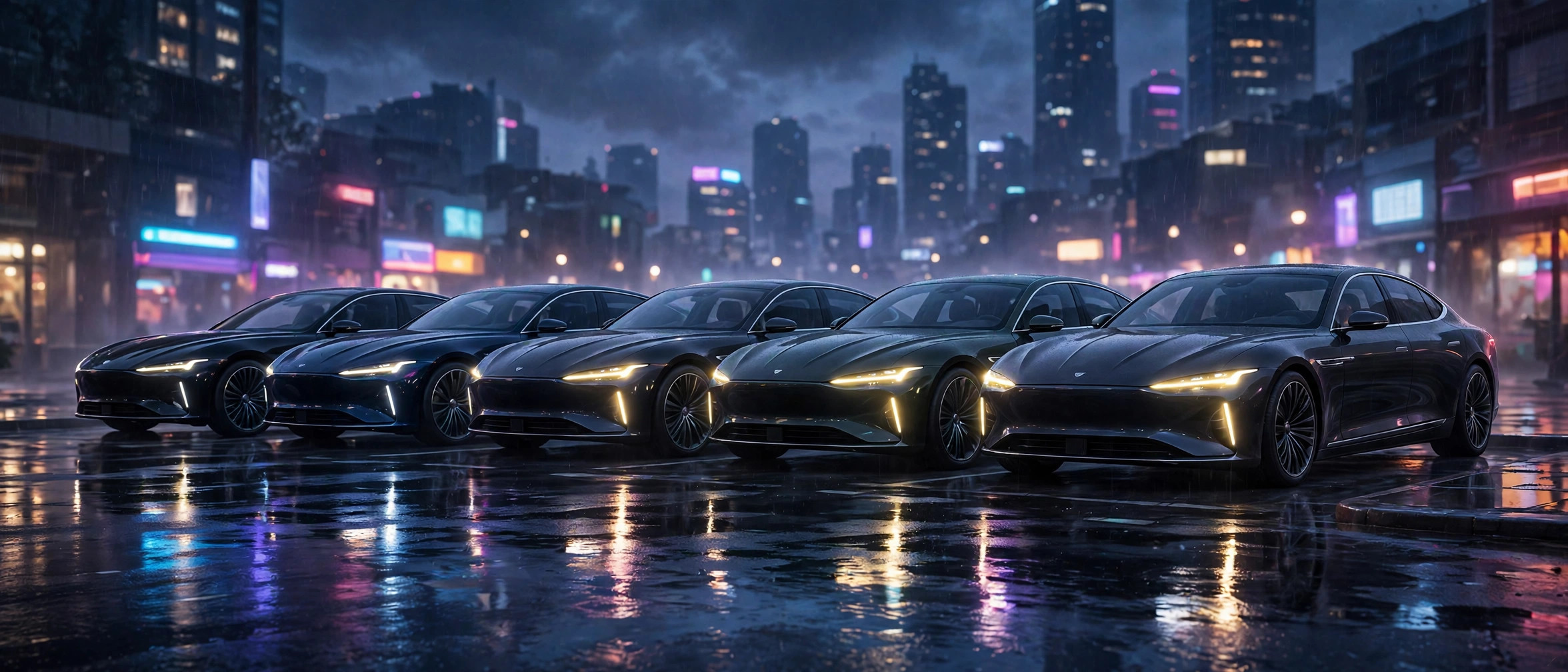
Week ten of the China Files, and this is the one last week promised: the big luxury saloons. America has mostly given up on the flagship sedan — the Germans still sell them, but the numbers are stark. A Mercedes-Benz S-Class starts at US$119,500, a BMW 7 Series at US$99,300 and a Genesis G90 at US$92,700 (all base MSRP, before destination). The cheapest full-size luxury electric saloon in America, the Lucid Air Pure, starts at US$70,900. China still takes the big sedan seriously — and the price spread this week says it all. From about US$31,000 to about US$145,000, every car below undercuts its German or American equivalent while offering faster charging, bigger batteries or more driver-assistance hardware. None of them is sold in America.
The lockout hasn't changed: Chinese vehicles face a 100% US tariff (in place since September 2024), a US Commerce Department rule finalised in January 2025 bars Chinese connected vehicles outright, and a Connected Vehicle Security Act is still pending in Congress. A note on the numbers: prices are Chinese domestic list prices with rough USD conversions (about 7 yuan to the dollar), and range figures are CLTC lab numbers — China's generous test cycle, so knock roughly 20–30% off for real-world driving. Every spec below was checked against a source today; where a figure hasn't been published, we say so.
1. Maextro S800 — Huawei's Maybach rival
Price: 708,000–1,018,000 yuan (approx. US$101,000–145,000). The pure-electric version starts at 708,000 yuan; the range-extender version runs to 1,018,000 yuan for the four-seat top trim.
Specs: The first car from the Maextro brand — Huawei's flagship arm, built with JAC — and it is enormous: 5,480 mm long on a 3,370 mm wheelbase, longer than an S-Class. The battery-electric version makes 390 kW (523 hp) with 673 Nm from two motors and does 0–100 km/h in 4.3 seconds; tri-motor versions run to 635 kW (852 hp). The battery is a 97 kWh CATL pack, good for 702 km or 650 km of CLTC range depending on configuration, and it charges 10–80% in 12 minutes. The range-extender version pairs a 65 kWh battery with a petrol engine for up to 1,333 km of combined range — sources disagree on its electric-only range, so we won't quote one. The cabin is the point: Huawei's ADS 4 driver assistance, a 43-speaker, 2,920-watt sound system, and 1,296-LED "Starry Splendour" headlights. The four-seat version is a rolling lounge with executive rear chairs.
What you're missing: The closest thing in America is the Mercedes-Maybach S 580, from US$207,150. The S800's top trim costs roughly US$145,000 in China — about US$60,000 less — and even its base car sits below a standard S-Class. A Maybach-rivalling lounge with tri-motor pace and 12-minute charging, for S-Class money. Huawei's name is on the tech, which is also why it will never be sold in America.
Sources: CnEVPost (Maextro S800 launch), Wikipedia (Maextro S800 specs), MotorGrail (S800 charging and range), Edmunds (2026 S-Class pricing), Edmunds (2026 Maybach pricing)
2. Hongqi H9 — the state limousine goes plug-in hybrid
Price: Two cars share this name, and the distinction matters. The all-new plug-in hybrid H9 opened pre-sales on 7 November 2026 at 329,800–419,800 yuan (approx. US$47,000–60,000) — but it is not yet on sale, and deliveries are still to follow. The car you can actually buy new in China today is the old petrol H9, at 329,800–539,800 yuan (approx. US$47,000–77,000).
Specs: The new car drops the V6 entirely. It's a 2.0-litre turbo plug-in hybrid: the engine makes 145 kW (197 PS / 194 hp), the all-wheel-drive version adds two motors for a combined 444 kW (604 PS / 595 hp). Hongqi quotes 0–100 km/h only as "in the 4-second range" — no precise figure has been published. The 40.4 kWh battery runs on an 800-volt platform with 6C charging, 30–80% in about 8 minutes, and over 1,400 km of combined range. The electric-only range needs a flag: Hongqi claims 275 km CLTC, but the Chinese regulatory filing lists 205–216 km — the maker's number and the filing disagree, so treat the 275 km figure with caution. The tech list is the most Huawei-flavoured of any Hongqi yet: Huawei Qiankun ADS 5 driver assistance, a 16.1-inch 3K cockpit screen, 16-degree bi-directional rear-wheel steering for a 5.35-metre turning radius, air suspension, and all four seats with ventilation, heating and massage. It's 5,230 mm long on a 3,120 mm wheelbase — 60 mm longer in the wheelbase than the old car. The old car, for the record, is a 2.0-litre turbo mild hybrid with 252 hp and 380 Nm (0–100 in 7.36 seconds measured) or a supercharged 3.0-litre V6 with 283 hp and 400 Nm.
What you're missing: This is the badge that ferries Chinese officials — the state limousine, in effect — now with a 604 hp plug-in hybrid, Huawei's latest driver assistance and rear-wheel steering. The new car's top trim costs roughly US$60,000 in China, less than a base Genesis G90 at US$92,700. America's flagship sedans don't come with a chauffeur-grade rear cabin at this price, and they never will at this price.
Sources: AllRight EV (new H9 pre-sale prices and specs), News18a (H9 trim prices and MIIT filing figures), GEMS (H9 performance and charging), Bitauto (old H9 price range and V6 specs), Edmunds (Genesis G90 pricing)
3. NIO ET7 — the three-minute refuel
Price: 428,000–458,000 yuan (approx. US$61,000–65,000) with the battery included. Battery-as-a-Service drops the purchase price to from 298,000 yuan plus a monthly battery lease — the lease fee itself wasn't published in the sources we read, so no number here. Note the current car is the 2024 model year; NIO hasn't facelifted it since.
Specs: Dual-motor all-wheel drive making 480 kW (653 PS / 644 hp) with 850 Nm, 0–100 km/h in 3.8 seconds. The standard battery is 100 kWh for 705 km of CLTC range (665 km on the Signature trim), and a 150 kWh semi-solid-state pack stretches that to 1,050 km CLTC — but the big pack is a swap upgrade, not a trim you buy outright. The swap is the whole point: a full battery change in about 3 minutes at one of NIO's 2,800-plus swap stations in China. The honest catch is the plug-in charging: peak DC is 180 kW, slow by 2026 flagship standards — the BYD below peaks at 1,000 kW. The rest is proper flagship kit: 33 sensors including LiDAR, the NOMI AI assistant, air suspension with adaptive damping, and a Euro NCAP five-star rating with 91% adult-occupant protection.
What you're missing: The only flagship saloon where "refuelling" takes three minutes — a full battery swap, no plug, no waiting — plus a 1,050 km range option. The closest American equivalent is the Lucid Air Pure at US$70,900 with 420 miles of EPA range. The ET7 gives you swap convenience and a chauffeur-grade rear cabin for less money — but you'd have to move to China (or Europe, where it's also sold) to buy one. Don't confuse it with the smaller, cheaper ET5 from week one.
Sources: Craveuo (NIO ET7 specs and pricing), AutoEdgeView (ET7 battery-as-a-service and swap network), Autoblog (2026 Lucid Air pricing)
4. BYD Han L — the megawatt flagship
Price: 219,800–279,800 yuan (approx. US$31,000–40,000) for the electric Han L at launch in April 2025. One database listing has since moved to 202,800–262,800 yuan, which looks like a price cut — either way, it's roughly US$29,000–37,500. The plug-in hybrid Han L DM runs 209,800–259,800 yuan (approx. US$30,000–37,000). Don't confuse the Han L with the older, smaller Han — the L is a new, larger car, and it's still sold alongside it.
Specs: The headline is the charging. The Han L EV runs BYD's 1,000-volt Super e-Platform at up to 1,000 kW peak — dual-gun — adding 400 km of range in 5 minutes, 10–70% in 6 minutes and 0–100% in 20 minutes. Nothing else in this list, and nothing sold in America, charges this fast. The rear-drive car makes 500 kW (671 hp) with 420 Nm and does 0–100 km/h in 5.5 seconds; the all-wheel-drive car makes 810 kW (1,086 hp) with 860 Nm and does it in 2.7 seconds. The battery is 83.2 kWh on every EV trim, for 701 km of CLTC range (rear-drive) or 601 km (all-wheel drive). LiDAR-based God's Eye B driver assistance is standard. The hybrid Han L DM makes 400 kW combined with 670 Nm from a 1.5-litre turbo and a 29.5 kWh battery, does 0–100 in 3.9 seconds in all-wheel-drive form, and claims over 1,400 km combined range — sources disagree on its electric-only range (145 km versus about 200 km CLTC), so treat that figure as unsettled.
What you're missing: A 2.7-second, megawatt-charging flagship saloon from about US$31,000 — less than half a Lucid Air Pure at US$70,900 — that adds 400 km of range in the time it takes to buy a coffee. The fastest-charging production sedan in this week's list, at a price no American flagship can touch.
Sources: CnEVPost (Han L launch), Data.CarNewsChina (Han L EV database), ChinaBYDAuto (Han L EV trim prices), Data.CarNewsChina (Han L DM database), iTiger (Han L DM combined range)
5. Stelato S9 — the German flagship experience at half the price
Price: From 319,800 yuan (approx. US$46,000) for the March 2026 refresh — the current car. Trim-by-trim pricing for that refresh hasn't been published, so the "from" figure is the honest number; the previous November 2025 facelift started at 309,800 yuan for the range-extender and 329,800 yuan for the electric version.
Specs: Huawei's second brand after Aito, built with BAIC, and it's a fast-moving target — three versions in nineteen months. The current car runs Huawei Qiankun ADS 4 driver assistance with four LiDARs standard, a HarmonyOS cockpit, air suspension with adaptive damping, and measures 5,160 mm long on a 3,050 mm wheelbase. The battery-electric version makes 227 kW with 396 Nm rear-drive or 385 kW (516 hp) with 673 Nm all-wheel drive, and does 0–100 km/h in 6.0 seconds (rear-drive) or 3.92 seconds (all-wheel drive). The 100 kWh battery gives 721 km or 816 km of CLTC range, and the 800-volt platform charges 30–80% in 15 minutes. The range-extender version does 260 km or 372 km on electricity alone depending on battery, with up to 1,378 km combined. There's a wagon sibling, the S9T, at the same starting price — but that's a story for another week.
What you're missing: S-Class-sized presence and four-LiDAR driver assistance for E-Class money. The electric S9's 816 km of CLTC range and 15-minute 30–80% charge start at roughly US$46,000 — less than half a BMW 7 Series at US$99,300 or an S-Class at US$119,500. If a German flagship were built in China, this is what it would cost.
Sources: CnEVPost (Stelato S9 March 2026 refresh), CnEVPost (Stelato S9 November 2025 facelift), Wikipedia (Stelato S9 specs), Edmunds (2026 BMW 7 Series pricing)
The bottom line
Ten weeks in, and the luxury saloon is where the gap is widest. A 1,086 hp BYD that charges at a megawatt for about US$31,000. A NIO that swaps its battery in three minutes. A Huawei-built Maybach rival for S-Class money, a state limousine gone plug-in hybrid for less than a base Genesis, and a German-flagship-sized Stelato for roughly US$46,000. America's flagship sedans start at US$70,900 and climb past US$200,000 — and none of them charges at 1,000 kW, swaps its battery, or comes with four LiDARs as standard. China still builds the big sedan properly. America just can't buy one.
The China Files is a weekly series — every Wednesday morning, US time, we dig up another batch of cars America can't have. Next week: the three-row family SUVs — China's big six- and seven-seaters America can't have.
Missed the earlier weeks? Read week one here, week two here, week three here, week four here, week five here, week six here, week seven here, week eight here and week nine here — then follow the blog or find us on YouTube. And if you want the gear we actually rate, browse the store.