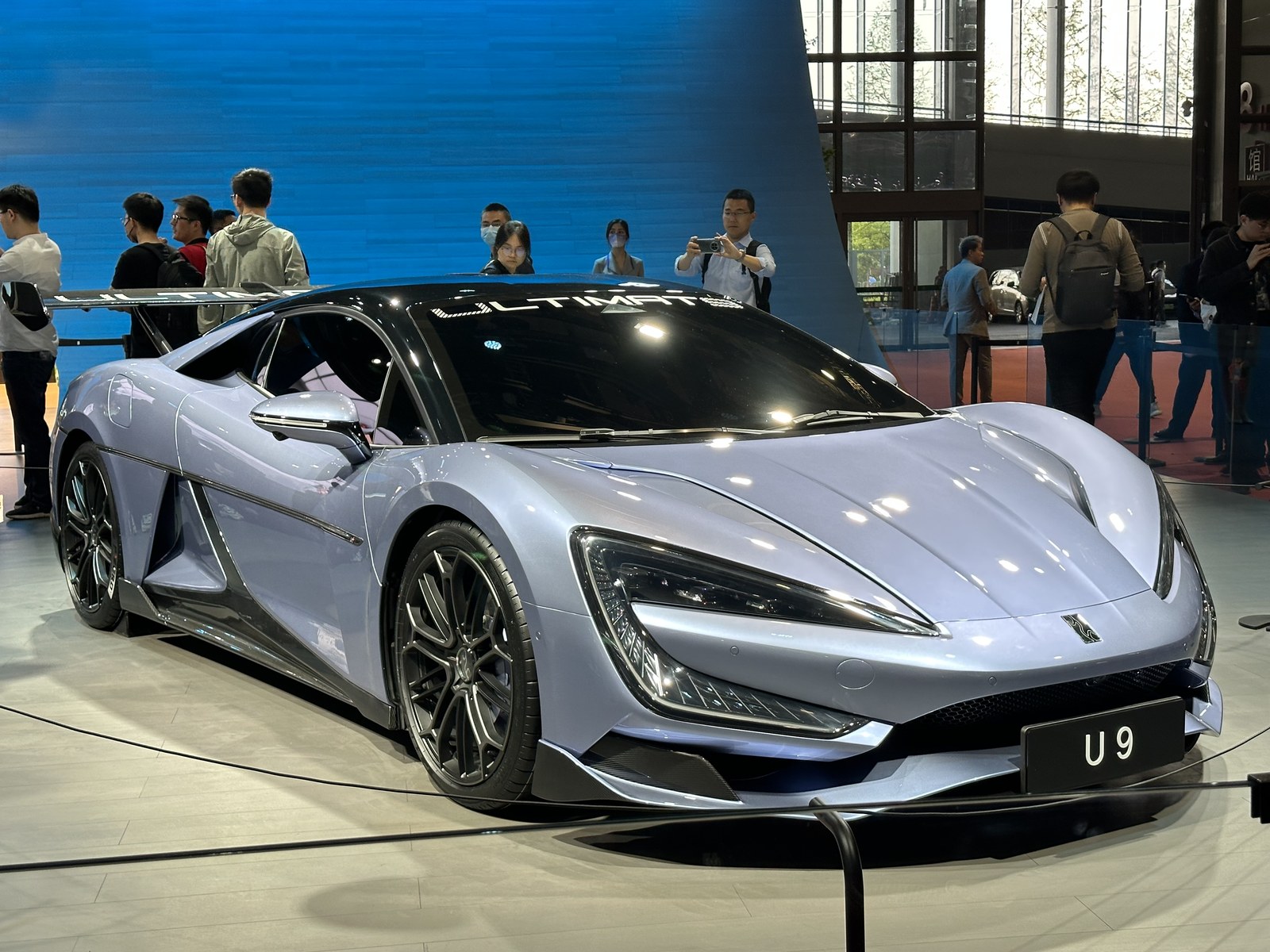
Week four of the China Files. Week one was the heavy hitters, week two was the brands you've never heard of, and week three went off-road. This week it's the exotics: the supercars, hyper-wagons and halo cars China builds to flex — including a 1,306hp electric supercar that can literally dance, and an electric roadster America gets to stare at through a fence.
The lockout hasn't changed: Chinese vehicles face a 100% US tariff (in place since September 2024), a US Commerce Department rule finalized in January 2025 bars Chinese connected vehicles outright — software restrictions from the 2027 model year, hardware from 2030 — and US senators are pushing to write the ban into permanent law. Quick note on the numbers: prices are Chinese domestic list prices with approximate USD conversions (around 7 yuan to the dollar, rounded), and range figures are CLTC lab numbers — China's optimistic test cycle, so knock roughly 20–30% off for real-world driving. Every spec below was checked against a source today.
1. BYD Yangwang U9 — the 1,306hp supercar that dances
Price: 1,800,000 yuan (approx. US$257,000) after a 120,000-yuan price hike announced in October 2025; the original launch price was 1,680,000 yuan
Specs: BYD's Yangwang halo car is no joke. Four electric motors (240 kW each) make 960 kW (1,306 hp) and 1,680 Nm, good for 0–100 km/h in 2.36 s, a 9.78-second quarter-mile and 309 km/h flat out. An 80 kWh BYD Blade LFP battery gives 450 km of CLTC range, and dual-gun charging on the 800V platform does 30–80% in about 10 minutes (one outlet reports up to 500 kW DC and 10–80% in 10 minutes, but that's a reported figure, not a BYD-confirmed one). The party piece is the DiSus-X body-control system: the U9 dances, jumps clear off the ground (75 mm of suspension lift) and can drive on three wheels. Four-motor torque vectoring also gives it tank turns, and it's the first Chinese car with a carbon-fiber unibody.
What you're missing: A 1,306hp all-electric supercar that can jump and dance — for money comparable to the 2026 Corvette ZR1 (US$182,000 base, 1,064 hp, 2.3 s 0–60 mph), which can't do either trick. And the flex goes further: the limited U9 Xtreme (30 units) set a verified 496.22 km/h top speed and lapped the Nürburgring in 6:59.157. America gets to watch the videos.
Sources: CnEVPost, Motorwatt (price hike + Xtreme records), VNAuto, Autoblog (Corvette ZR1 specs/pricing)
2. Hyper SSR — the 1.9-second Chinese hypercar
Price: 1,286,000 yuan (approx. US$184,000) base; 1,386,000 yuan (approx. US$198,000) Speed Version; 1,686,000 yuan (approx. US$241,000) Ultimate Track Version
Specs: GAC's Aion Hyper SSR — the Hyper brand was renamed Hyptec in August 2024 — was China's first electric hypercar. 900 kW (1,224 hp) and 1,230 Nm, with 0–100 km/h in 2.3 s for the base trim (rear-wheel drive) and a claimed 1.9 s for the all-wheel-drive top trims, limited to 250 km/h. A 74.69 kWh ternary NMC battery gives 506 km of CLTC range. One honest gap: no DC charging speed or power figure has been published anywhere — so none here. The hardware around it is the real deal though: carbon-fiber body, butterfly doors, an active rear spoiler making 100 kg of downforce, carbon-ceramic brakes and a 900V silicon-carbide electrical architecture.
What you're missing: A sub-two-second electric hypercar starting at the equivalent of about US$184,000 — a 1.9-second claim against the Corvette ZR1's 2.3-second 0–60, for roughly ZR1 money. Whether you'd trust a GAC badge at that price is a different conversation, but the hardware is real.
Sources: Wikipedia, Gari.pk, Autoevolution, EnergyTrend
3. Zeekr 001 FR — the 930 kW wagon that hunts Plaids
Price: 769,000 yuan (approx. US$110,000); production limited to 99 cars per month
Specs: Zeekr took the 001 shooting brake and turned it into something unhinged: four silicon-carbide permanent-magnet motors making 930 kW (1,248 hp) and 1,280 Nm (some outlets report 943 kW — either way, four figures of horsepower in a wagon). 0–100 km/h in 2.36 s from a standing start (2.07 s rolling-start, Tesla-style measurement), 280 km/h top speed. A 100 kWh CATL Qilin battery on an 800V architecture does 10–80% in about 15 minutes — though no peak kW figure is published, and no CLTC range figure was published for the FR trim specifically, so don't ask. Chassis hardware: AP Racing 10-piston front / 4-piston rear calipers with Brembo carbon-ceramic discs, a carbon-fiber aero kit rated to 1.4G of lateral grip, quad-motor torque vectoring with tank turns, and a claimed first-production-car satellite communications pack. There's even a Kimi Räikkönen drive mode that bumps output to 1,282 hp via over-the-air update.
What you're missing: Zeekr positioned this thing against the Tesla Model S Plaid itself (1,020 hp, $109,990 MSRP — a car now discontinued with Fremont production ended). But the cleaner comparison is the 2025 Audi RS6 Avant Performance: US$126,600, 621 hp, 3.3 s 0–60 mph. The FR brings roughly double the power, all-electric, for the equivalent of about US$110,000. A Plaid-fighting wagon America will never see.
Sources: Gari.pk, Carsifu, NewMobility, Autoblog (RS6 Avant specs/pricing)
4. MG Cyberster — the electric roadster America doesn't get
Price: 319,800–359,800 yuan (approx. US$45,700–51,400)
Specs: An SAIC-built, MG-badged, all-electric two-seat roadster. The top all-wheel-drive trim makes 400 kW (544 hp) and 725 Nm, hits 0–100 km/h in 3.2 s and tops out at 200 km/h. A 77 kWh ternary NMC battery gives 520 km of CLTC range. Charging honesty: Chinese sources haven't published a DC charging figure, so all we have is the UK-market number — 150 kW max, 10–80% in about 38 minutes. The standout is the doors: electrically operated scissor doors, which is not a sentence you expect next to a ~US$46,000 price tag. It's on sale in the UK from £54,995 and in Australia from under A$100,000 — but MG has no plans to enter the North American market, so it's staying behind the same wall as everything else here.
What you're missing: Here's the gut punch: there is no electric roadster on sale in the US at all. Tesla's Roadster remains vaporware. The closest things with actual dealer lots are the Mazda MX-5 Miata (US$30,430, 181 hp, petrol) and the BMW Z4 (US$57,450) — both combustion, both less powerful, neither with scissor doors. The one electric convertible in its price class lives everywhere except America.
Sources: CarNewsChina database, InsideEVs, EV Fleet World (UK charging figure), Electric Cars Report, The Driven (Australia pricing)
5. Denza Z9 GT — the tank-turning 1,140hp shooting brake
Price: 269,800–369,800 yuan (approx. US$38,500–52,800)
Specs: BYD's Denza brand built a flagship shooting brake and then lost the plot in the best way. The EV flagship's e³ tri-motor setup — 230 kW up front, 310 kW on each rear wheel — is reported at a combined 850 kW (about 1,140 hp), though one outlet the same day reported 770 kW (1,032 hp); either way, with 1,210 Nm, 0–100 km/h in 2.8 s (2.7 s in Performance trim) and a 240–270 km/h top speed. A 122.5 kWh second-generation Blade battery gives 860 km of CLTC range, and "flash charging" takes it from 10–70% in 5 minutes. There's also a plug-in hybrid version (640 kW system, 63.8 kWh LFP battery, 401 km of CLTC electric-only range — though no 0–100 time was published for it). The party tricks: rear-wheel steering with a 4.62-metre turning radius, "compass turns" (pivot the car on the spot), God's Eye 5.0 driver assistance and DiSus-A air suspension. This is a luxury family wagon that can spin in place.
What you're missing: Compare the German establishment: the 2026 BMW M5 Touring starts at US$123,900–125,300 with 717 hp from its plug-in hybrid powertrain, and the Audi RS6 Avant Performance from about US$126,600 with 621 hp. The Z9 GT flagship starts at the equivalent of roughly US$49,000, outguns both by hundreds of horsepower, and can tank-turn into a parking spot neither of them can. Europeans get it (from over €101,000 there) — Americans don't get it at all.
Sources: CnEVPost, CarNewsChina (tri-motor trim), Electrek, CarNewsChina (pricing + PHEV), Autoblog (M5 Touring / RS6 pricing)
The bottom line
Four weeks in, the pattern's hard to miss: China isn't just building cheap commuters. It's building a 1,306hp supercar that dances, a sub-two-second hypercar, a 930 kW wagon with a satellite phone in it, the only electric roadster in its price class on the planet — and a tank-turning family wagon with four figures of horsepower starting at about US$49,000. None of them are sold in America, and the tariff wall keeps them out while the rest of the world shops.
The China Files is a weekly series — every Wednesday morning, US time, we dig up another batch of cars America can't have. Next week: the luxury people-movers — the Denza D9, the Zeekr 009 and China's take on the minivan, done properly.
Missed the earlier weeks? Read week one here, week two here and week three here — then follow the blog or find us on YouTube so you don't miss it. And if you want the gear we actually rate, browse the store.