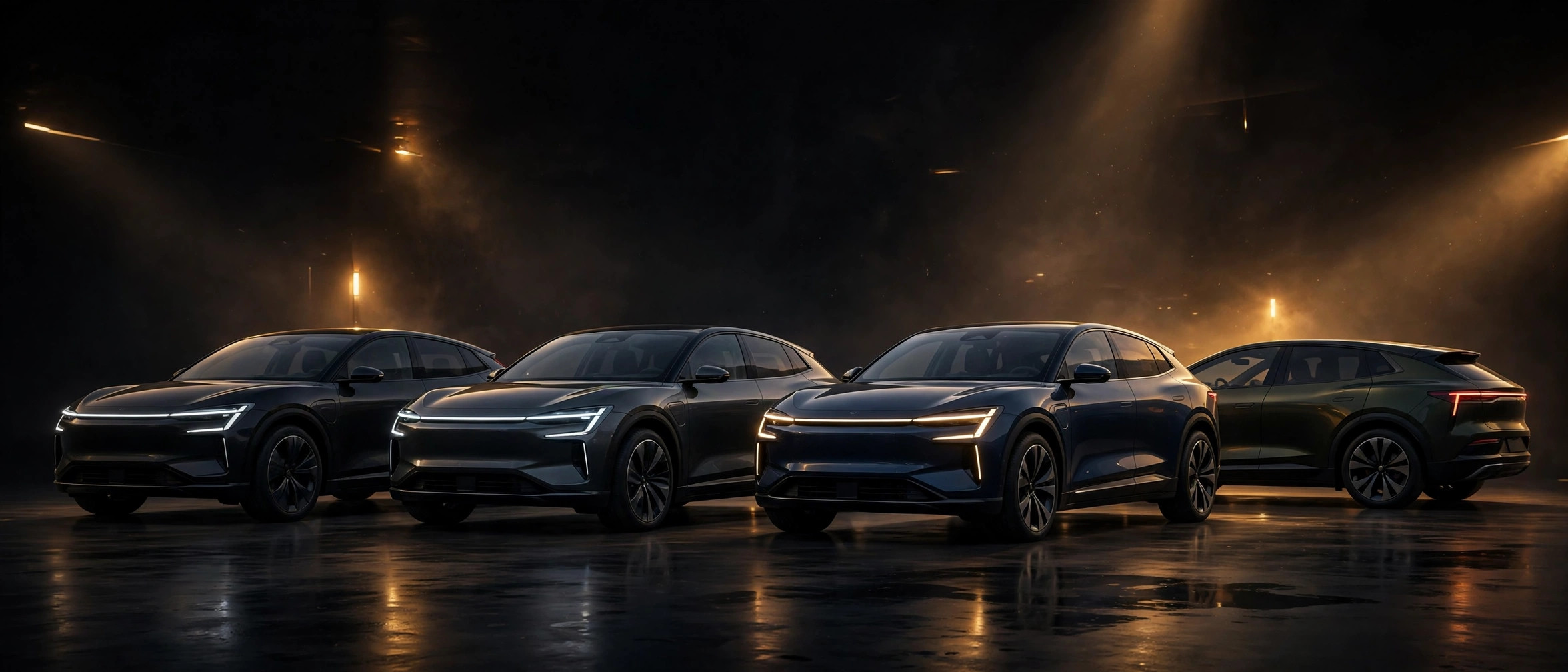
Week seven of the China Files, and we're back to the segment that matters most: the family SUV. Week one was the heavy hitters, week two was the brands you've never heard of, week three went off-road, week four was the exotics, week five was the SUVs and week six was the luxury people-movers. This week it's six more SUVs, and the same three things keep showing up: 800-volt charging, range-extender versions for people who aren't ready to go fully electric, and prices that undercut America's best-selling EV by thousands.
The lockout hasn't changed: Chinese vehicles face a 100% US tariff (in place since September 2024), a US Commerce Department rule finalized in January 2025 bars Chinese connected vehicles outright, and a Connected Vehicle Security Act is still pending in Congress. A note on the numbers: prices are Chinese domestic list prices with rough USD conversions (about 7 yuan to the dollar), and range figures are CLTC lab numbers — China's generous test cycle, so knock roughly 20–30% off for real-world driving. Every spec below was checked against a source today; where a figure hasn't been published, we say so.
1. XPeng G6 — the one with a 1,704 km range-extender version
Price: 176,800–186,800 yuan (approx. US$25,300–26,700) for the versions covered here.
Specs: Every version runs a single rear motor making 218 kW (292 hp) and 450 Nm. The battery-electric car carries a 68.5 kWh battery for 625 km of CLTC range and does 0–100 km/h in 6.4 s. The range-extender version pairs a 55.8 kWh battery with a 1.5-litre engine that only charges the battery, never drives the wheels: 430 km of CLTC electric range and 1,704 km combined, 0–100 in 6.7 s. Charging: 800V architecture, 10–80% in about 12 minutes for the battery car, with a peak DC rate of 382 kW. Standard kit includes a Turing AI chip and a 15.6-inch centre display.
What you're missing: The US Tesla Model Y starts at US$39,990. The G6 gives you 800V, 12-minute charging and a range-extender version with 1,704 km of combined range for roughly US$14,000 less than the cheapest Model Y — and America doesn't get a range-extender SUV at any price.
Sources: CnEVPost (XPeng G6), Paul Tan (G6 range-extender), GetTesla (Model Y pricing)
2. XPeng G9 — the flagship that charges in 12 minutes
Price: 248,800–278,800 yuan (approx. US$35,500–39,800).
Specs: The rear-drive versions make 258 kW, the dual-motor all-wheel-drive version makes 423 kW with 695 Nm and does 0–100 km/h in 4.2 s (rear-drive cars: 6.4–6.6 s). Battery choice is 79 kWh for 625 km of CLTC range or 93.1 kWh for 725 km rear-drive / 680 km all-wheel-drive. Charging: 800V throughout, 10–80% in about 12 minutes, with peak DC rates of 445 kW on the smaller battery and 530 kW on the larger one.
What you're missing: Tesla's six-seat family flagship, the Model Y L, costs US$61,990. The G9's top trim lands at roughly US$39,800 in China — 12-minute charging and up to 725 km of CLTC range for about US$22,000 less than Tesla's big family car.
Sources: CnEVPost (XPeng G9), GetTesla (Model Y pricing)
3. Avatr 07 — the Huawei-powered lounge
Price: 219,900–279,900 yuan at launch (approx. US$31,400–40,000).
Specs: Avatr is the Changan, Huawei and CATL joint venture, and the 07 shows it: Huawei ADS 4 driver assistance, HarmonyOS 5, a 35.4-inch 4K screen and a 25-speaker Meridian system. The range-extender runs 231 kW rear-drive or 362 kW combined all-wheel-drive, with a 39.05 kWh battery for 245 km of CLTC electric range and 1,115 km combined (an optional 52.01 kWh pack stretches electric range to 333 km). The battery car runs 252 kW rear-drive or 440 kW all-wheel-drive with an 82.16 kWh battery for 610–650 km of CLTC range. The 0–100 km/h time for the 07 hasn't been published in the sources we read — don't confuse it with the larger, newer 07L — so no number here. Zero-gravity front seats and an optional 4-litre fridge round it out.
What you're missing: The US Tesla Model Y starts at US$39,990. The Avatr 07 gives you a Huawei-powered cabin, a proper luxury interior and a range-extender good for 1,115 km for roughly Model Y money — and the top launch trim still lands at about US$40,000.
Sources: CarNewsChina (2026 Avatr 07), GetTesla (Model Y pricing)
4. IM Motors LS6 — the one that steers by wire, standard
Price: 202,900–264,900 yuan (approx. US$29,000–37,800); after incentives, 197,900–259,900 yuan (approx. US$28,300–37,100).
Specs: Launched 23 September 2026. The chassis is what stands out: steer-by-wire and four-wheel steering are standard on every trim — the stuff other brands reserve for flagships or concept cars. Power runs 245 kW rear-drive, 300 kW rear-drive, or 500 kW dual-motor all-wheel-drive, with 0–100 km/h in 6.4 s, 5.4 s and 3.48 s respectively. Batteries are 76 kWh for 650 km of CLTC range, 93 kWh for 782 km and 103 kWh for 750 km, all on 800V with up to 396 kW charging and 10–80% in roughly 17–20 minutes depending on trim. Torque hasn't been published, so no number here. Inside: 27.1-inch 5K dual screens, a 15.6-inch passenger display, LiDAR-based driver assistance, 4D massage seats and an 11-litre fridge.
What you're missing: The US Tesla Model Y starts at US$39,990. The LS6 undercuts it by roughly US$12,000 at the entry price, adds a by-wire chassis you won't find as standard on American SUVs, and tops out at 3.48 seconds to 100 km/h.
Sources: CnEVPost (next-gen LS6), GetTesla (Model Y pricing)
5. Leapmotor C11 — the 800V SUV for about US$21,000
Price: 143,800–159,800 yuan (approx. US$20,500–22,800) for the June 2026 refresh.
Specs: The battery car makes 220 kW with 360 Nm, does 0–100 km/h in 6.1 s and carries an 81.9 kWh battery for 640 km of CLTC range on an 800V platform. The range-extender makes 200 kW with 320 Nm, does 0–100 in 7.6 s and pairs a 41.7 kWh battery with a petrol generator for 300 km of CLTC electric range and 1,220 km combined. A 10–80% charge time hasn't been published in the sources we read, so no number here. Kit includes a 17.3-inch floating centre screen, a 60-inch augmented-reality head-up display, a Snapdragon SA8295P chip and frameless doors, with LiDAR versions available.
What you're missing: The US Hyundai Ioniq 5 starts at US$35,000 for the 2026 model. The C11 gives you 640 km of CLTC range and an 800V platform for roughly US$14,500 less — plus a 1,220 km range-extender option America doesn't get at any price.
Sources: CnEVPost (updated C11 specs), CnEVPost (Leapmotor C11 refresh), TopSpeed (Ioniq 5 pricing)
6. Li Auto L7 — the five-seat flagship with 286 km of electric range
Price: 301,800–359,800 yuan (approx. US$43,100–51,400) for the 2025 refresh.
Specs: Every trim runs the same dual-motor all-wheel-drive setup: 330 kW (443 hp) and 620 Nm, 0–100 km/h in 5.3 s. The Pro trim carries a 42.8 kWh battery for 225 km of CLTC electric range and 1,360 km combined; Max and Ultra step up to 52.3 kWh for 286 km electric and 1,421 km combined, with a 1.5-litre range extender. A 10–80% charge time hasn't been published, so no number here. At 5,050 mm long with just five seats, it's a flagship-size car with a living-room cabin.
What you're missing: Tesla's six-seat Model Y L costs US$61,990 and has no range-extender version at all. The L7's top trim lands at roughly US$51,400 in China, with 286 km of pure electric range before the petrol generator even wakes up — the family SUV for people who want electric driving without ever thinking about a charger on a road trip.
Sources: Wikipedia (Li L7 specs), GetTesla (Model Y pricing)
The bottom line
Seven weeks in, the SUV story splits two ways. Battery side: 12-minute 800V charging on the G6 and G9, 800V at about US$21,000 in the C11, and a by-wire chassis as standard on the LS6. Range-extender side: 1,704 km in the G6, 1,421 km in the L7, 1,220 km in the C11 — while America has no range-extender SUV at any price. The lockout is the reason US buyers can't shop any of it.
The China Files is a weekly series — every Wednesday morning, US time, we dig up another batch of cars America can't have. Next week: the city cars and the cheap seats — the little EVs and runabouts that cost less than a used Camry back home.
Missed the earlier weeks? Read week one here, week two here, week three here, week four here, week five here and week six here — then follow the blog or find us on YouTube so you don't miss it. And if you want the gear we actually rate, browse the store.