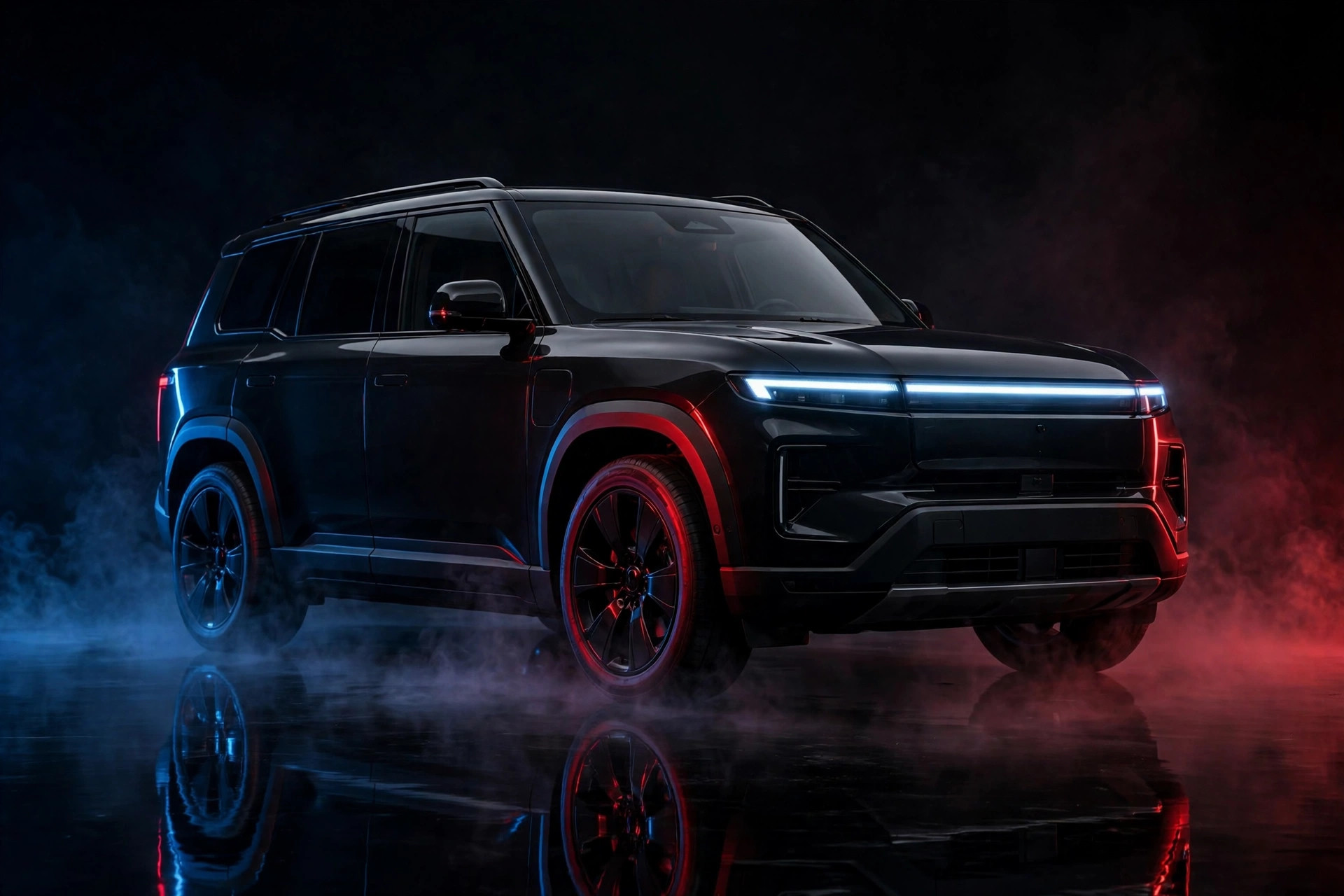
Week five of the China Files. Week one was the heavy hitters, week two was the brands you've never heard of, week three went off-road and week four was the exotics. This week it's the family haulers: the Chinese SUVs America can't have — and honestly, the exotics were just a flex. These are the ones that would actually sting if they showed up. A 990-horsepower Xiaomi, a plug-in hybrid that adds charge in 12 minutes, and a three-row luxury SUV that crab-walks into parking spots.
The lockout hasn't changed: Chinese vehicles face a 100% US tariff (in place since September 2024), a US Commerce Department rule finalized in January 2025 bars Chinese connected vehicles outright — software restrictions from the 2027 model year, hardware from 2030 — and US senators are pushing to write the ban into permanent law. A note on the numbers: prices are Chinese domestic list prices with rough USD conversions (about 7 yuan to the dollar), and range figures are CLTC lab numbers — China's generous test cycle, so knock roughly 20–30% off for real-world driving. Every spec below was checked against a source today; where a figure hasn't been published, we say so.
1. Xiaomi YU7 — the 990hp phone-maker's SUV
Price: 233,500 yuan (approx. US$34,300) for the new base Standard trim; 329,900 yuan (approx. US$48,500) for the Max; 389,900–429,900 yuan (approx. US$57,300–63,200) for the GT flagship. For context, the China-market Tesla Model Y starts at 263,500 yuan — the YU7 undercuts it on every trim.
Specs: The Standard runs 235 kW (315 hp, torque not published) with a 73.0 kWh LFP battery: 643 km of CLTC range and 0–100 km/h in 5.9 s. The Max makes 508 kW (681 hp) and 866 Nm, hits 0–100 in 3.23 s, and pairs a 101.7 kWh CATL NMC battery (760 km CLTC) with a 12-minute 10–80% charge on its 871V silicon-carbide platform — no official peak DC kW figure has been published, so take the "500+ kW" citations for what they are. The GT flagship is 738 kW (990 hp) and does 2.92 s to 100, with torque and charge-time figures not published yet. The standout trick is the ADAS hardware: a 128-line Hesai LiDAR is standard on every trim, even the base car, feeding 700 TOPS of NVIDIA DRIVE Thor-U. There's also a 1.1-metre-wide three-panel Mini-LED head-up display, a Snapdragon 8 Gen 3 HyperOS cockpit and 0.245 drag. This thing logged 200,000 pre-orders in three minutes at launch and outsold the Model Y in China in January 2026 — though five straight months of sliding deliveries (8,736 in May) forced the cheaper base trim and the GT.
What you're missing: The US Tesla Model Y starts at US$39,990 (321 miles of EPA range), and the 3.3-second 0–60 Performance costs US$57,490. The YU7 Max gives 681 hp, 3.23 s and a 12-minute charge at the equivalent of about US$48,500 — with LiDAR driver-assistance hardware standard even on the US$34,300 base car. That combination doesn't exist in America at any price.
Sources: Wikipedia, Eletric-Vehicles (sales), Carsales (Max review), Autoblog (Model Y pricing)
2. Li Auto L6 — the plug-in hybrid that refuels like a petrol car
Price: one trim — the new L6 Ultra at 249,800 yuan (approx. US$36,900).
Specs: A range-extender setup: 300 kW (402 hp) dual-motor all-wheel drive with a reported 529 Nm (not from an official spec sheet), 5.4 s 0–100, a 1.5-litre turbo engine (113 kW) that only ever generates electricity, and a 51 kWh LFP "supercharging" battery good for 300 km of CLTC electric range — 245 km is published on the stricter WLTC, and knock the usual 20–30% off CLTC for real-world. Combined range is 1,250 km CLTC with a 50-litre tank. The party piece is the charging: 260 kW peak DC, 20–80% in 12 minutes — on a plug-in hybrid, which is unheard of — though it needs Li Auto's 5C/4C dual-gun charger, of which there are over 4,100 stations in China. There's also 3.5 kW vehicle-to-load, a 29-inch 6K panoramic front display, zero-gravity seats, an 8.8-litre compressor fridge, a 19-speaker 1,920 W Dolby Atmos system and LiDAR + Li Auto's in-house 1,280-TOPS Mach M100 ADAS chip with city NOA. Fuel consumption for the 2026 Ultra hasn't been published, so we won't quote it.
What you're missing: The closest US-market rival is the 2026 Mazda CX-90 PHEV (US$50,495 base, 323 hp, 27 miles of EPA electric range, ~2 hours on a Level 2 wall box). The L6 costs roughly US$13,000 less, offers about five times the electric range even after the CLTC haircut, refuels in 12 minutes on DC fast charging instead of overnight, and ships LiDAR driver assistance. America's plug-in hybrids look slow-motion by comparison.
Sources: CnEVPost, EVExperts (L6 specs), Autoblog (CX-90 PHEV pricing), Edmunds (CX-90 PHEV specs)
3. Zeekr 7X — the 900V family SUV that charges in 10 minutes
Price: 229,800 yuan (approx. US$32,800) for the 75 kWh Max RWD (early-order price drops to 219,800 yuan, about US$31,400); 249,800 yuan (approx. US$35,700) for the 103 kWh Max Long Range; 269,800 yuan (approx. US$38,500) for the 585 kW Ultra AWD.
Specs: The two upper trims run 900V silicon-carbide architecture — one of the first mainstream midsize BEV SUVs on it. The Max Long Range (370 kW, 535 Nm, 5.1 s) packs a 103 kWh CATL Qilin NMC battery: 802 km of CLTC range (~560 km real-world) and 10–80% in 10 minutes on 6C-class charging (no official peak kW published, so no number here). The Ultra AWD makes 585 kW (785 hp) and 812 Nm, hits 0–100 in 2.98 s, and still claims 715 km of CLTC range. The base 75 kWh car does 620 km CLTC on 800V with a 10.5-minute 10–80%. Across the range: LiDAR + NVIDIA Drive Thor-U (700 TOPS) G-Pilot H7 driver assistance standard on every trim, adaptive air suspension, auto-opening frameless doors, a 36.2-inch AR-HUD, a rear-seat lounge spec (leg rest, power desk, fridge, sunshades) and a 41,000 Nm/deg torsional rigidity figure.
What you're missing: The Tesla Model Y Performance costs US$57,490 and does 0–60 mph in 3.3 s. The 7X Ultra is quicker (2.98 s), charges 10–80% in 10 minutes, ships LiDAR and air suspension plus a rear fridge, and costs the equivalent of about US$38,500 — roughly two-thirds of the Tesla. There is no 900V mainstream SUV on sale in the US at any price.
Sources: CarNewsChina (2026 facelift), FreshMotors (facelift specs), TrendyTechTribe (Model Y trims/pricing)
4. Denza N9 — the 912hp three-row that crab-walks
Price: 409,800–469,800 yuan (approx. US$56,900–65,250) for the N9 Flash Charge Edition.
Specs: BYD's Denza brand built a full-size luxury SUV and gave it the lot. A 2.0-litre turbo (152 kW) plus three motors — 200 kW up front, 240 kW on each rear wheel — via BYD's e³ platform: 680 kW (912 hp) and 1,035 Nm, 3.7 s 0–100, 230 km/h top speed. The 75.3 kWh second-generation Blade battery gives 420 km of CLTC electric-only range (~290–335 km real-world) and 1,520 km combined. Charging is the headline: 10–70% in 5 minutes, 10–97% in 9 minutes, with only a 3-minute penalty at -30°C (no peak DC kW published). The e³ platform's independent rear-motor steering gives it crab walking, compass U-turns and a 4.65-metre turning radius on a 5.26-metre, six-seat, three-row SUV. Plus God's Eye 5.0 ADAS with a roof LiDAR, DiSus-A air suspension with road preview, a 50-inch AR-HUD, a 17.3-inch central screen plus two 13.2-inch screens, and Devialet audio.
What you're missing: America's flagship luxury SUV, the 2026 Cadillac Escalade, starts at US$93,995 delivered with a 420-hp V8 — and has no electrified option at all. The N9 Flash Charge Edition costs the equivalent of about US$57,000, makes 912 hp, runs 420 km of CLTC range on electricity alone, and recharges 10–97% in 9 minutes. Nine hundred horsepower, six seats, crab-walks — for US$37,000 less than a base Escalade. There's no deal like that in the US, because the car isn't allowed in.
Sources: CnEVPost (Flash Charge Edition), CnEVPost (N9 launch), Edmunds (Escalade pricing/specs), RoadEthos (Escalade specs)
5. Onvo L60 — the EV with a 3-minute refuel
Price: 192,800–222,800 yuan (approx. US$28,400–32,900) with the 60 kWh battery; the battery-as-a-service option starts at 135,800 yuan (approx. US$20,000) with roughly 600 yuan/month battery rental.
Specs: NIO's Onvo sub-brand built a midsize SUV aimed straight at the Model Y. Single-motor RWD makes 240 kW (322 hp, 305 Nm), 5.9 s 0–100; the dual-motor AWD makes 340 kW (456 hp, 440 Nm), 4.6 s. Two battery options: 60 kWh (560 km CLTC RWD / 530 km AWD) or 85 kWh (+29,000 yuan) with 740 km CLTC on the RWD and 707 km AWD. The NT3.0 900V SiC platform does 10–80% in about 25 minutes (no peak DC kW published). But charging is beside the point: the L60 uses NIO's battery-swap network — ~3 minutes for a full battery — a multi-thousand-station network NIO keeps expanding, with autonomous station entry/exit on high trims. The top trims get LiDAR and NIO's in-house 5 nm Shenji NX9031 chip (over 1,000 TOPS) — flagship NIO driver-assistance tech in a ~200,000-yuan car — plus a family kit: 763-litre boot, a foldable 17.3-inch rear screen, tray table, a 6-litre cooler/heater, panoramic roof and a claimed 0.229 Cd drag figure — claimed, not independently verified.
What you're missing: The top Ultra+ AWD (456 hp, 4.6 s, LiDAR ADAS, up to 707 km CLTC — or 740 km on the RWD trim) costs the equivalent of about US$32,900 with the battery — under a base US Model Y (~US$40,000). Or take the battery-as-a-service entry at about US$20,000 with a 3-minute battery swap. No US-market EV offers a swap network at any price. A three-minute-refuel EV for less than the cheapest Model Y — and America can't buy it.
Sources: CnEVPost (updated L60), Gasgoo (price cut + ADAS), TrendyTechTribe (Model Y pricing)
The bottom line
Five weeks in, and it's the SUVs — not the exotics — that should have Detroit sweating. The pattern: 990hp for US$63,000-equivalent, a 900V family SUV that charges in 10 minutes, a plug-in hybrid that DC-fast-charges in 12, a 912hp three-row that crab-walks, and a three-minute battery swap network — all LiDAR-equipped, all priced like mid-range Hyundais back home. These aren't cheap commuters and they aren't halo cars. They're the family cars America's mainstream buyers actually shop for, built to a spec sheet no US maker is matching — and the tariff wall keeps them out while the rest of the world shops.
The China Files is a weekly series — every Wednesday morning, US time, we dig up another batch of cars America can't have. Next week: the luxury people-movers — the Denza D9, the Zeekr 009 and China's take on the minivan, done properly.
Missed the earlier weeks? Read week one here, week two here, week three here and week four here — then follow the blog or find us on YouTube so you don't miss it. And if you want the gear we actually rate, browse the store.