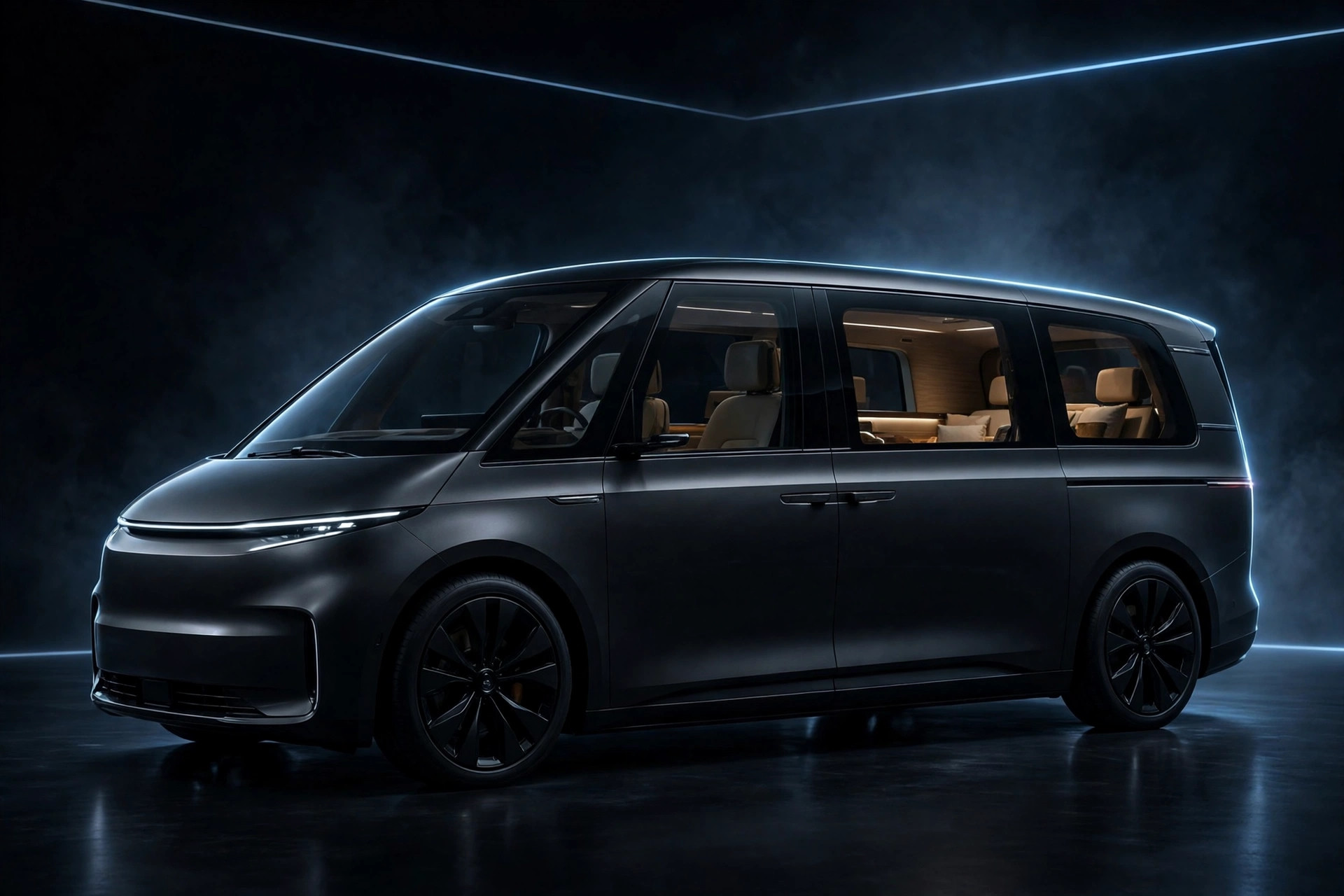
Week six of the China Files, and as promised last week, it's the luxury people-movers. Week one was the heavy hitters, week two was the brands you've never heard of, week three went off-road, week four was the exotics and week five was the SUVs. This week it's the cars America forgot how to build: the minivan, done properly. In China the people-mover isn't a punishment for having kids — it's where the chauffeur-grade seats, the fridges and the 4K ceiling screens live.
The lockout hasn't changed: Chinese vehicles face a 100% US tariff (in place since September 2024), a US Commerce Department rule finalized in January 2025 bars Chinese connected vehicles outright, and a Connected Vehicle Security Act is still pending in Congress. A note on the numbers: prices are Chinese domestic list prices with rough USD conversions (about 7 yuan to the dollar), and range figures are CLTC lab numbers — China's generous test cycle, so knock roughly 20–30% off for real-world driving. Every spec below was checked against a source today; where a figure hasn't been published, we say so.
1. Denza D9 — the one that charges in 5 minutes
Price: 359,800–469,800 yuan (approx. US$51,400–67,100) for the refreshed 2026 range.
Specs: Take your pick of powertrains. The EV runs a 115 kWh BYD Blade battery: 340 kW (456 hp) front-wheel drive, or 410 kW (550 hp) all-wheel drive with a 70 kW rear motor, and 800 km of CLTC range in front-wheel-drive form (750 km AWD). The plug-in hybrid pairs a 1.5-litre turbo with a 66.5 kWh battery for 401 km of CLTC electric-only range — no combined system-power total has been published, so we won't add the motors together and pretend it has. The headline is the charging: BYD's Flash Charging does 10–70% in 5 minutes and 10–97% in 9 minutes, with only about a 3-minute penalty at minus 30 degrees. Seven seats in a 2+2+3 layout, second-row captain's chairs with heating, ventilation, massage and power leg rests, a fridge that runs from minus 6 to 50 degrees, and God's Eye 5.0 driver assistance.
What you're missing: The US Toyota Sienna runs from US$41,615 to US$59,305 — and it's hybrid-only, with no plug-in version and no full EV at all. The D9 gives you an 800 km electric people-mover, or a plug-in with 401 km of electric range, that recharges in the time it takes to buy a coffee. America's best-selling minivan shape doesn't come close.
Sources: CarNewsChina (refreshed D9), Data.CarNewsChina (D9 EV specs), The Weekly Driver (US minivan pricing)
2. Zeekr 009 — the 3.9-second minivan
Price: 439,800–469,800 yuan (approx. US$62,800–67,100) for the updated 2026 standard range; limited-time post-entitlement prices run 413,800–443,800 yuan.
Specs: The single-motor version makes 310 kW with a 108 kWh CATL Qilin battery on 800V: 740 km of CLTC range, 0–100 km/h in 6.9 s, and 10–80% in 11.5 minutes. The dual-motor Ultra+ steps up to 680 kW, a 115 kWh battery on 900V, 720 km of CLTC range, 0–100 in 3.9 s and 10–80% in 10 minutes. Torque for the updated dual-motor car hasn't been published, so no number here — the 810 Nm figure floating around is from the older 2024 car. Six or seven seats and massage seats. And if you want the full chauffeur spec, the four-seat 009 Grand runs 789,000 yuan (approx. US$112,700), with a gold-trimmed Collector's Edition at 899,000 yuan (approx. US$128,400).
What you're missing: Stateside, the Kia Carnival Hybrid SX Prestige costs US$55,035, and the Sienna Platinum AWD is US$59,305. Neither does 0–100 in 3.9 seconds, neither charges at 900V, and neither offers a four-seat gold-trimmed chauffeur edition. China's is a 680 kW electric lounge.
Sources: EVMagz (updated 009), CnEVPost (009 Grand Collector's Edition), The Weekly Driver (US minivan pricing)
3. Li Auto Mega — the bullet train with seats
Price: 509,800 yuan (approx. US$72,800) for the single 2026 Home version.
Specs: All-electric, and shaped like nothing else on the road — a 0.215 drag coefficient on a seven-seat people-mover. 413 kW (554 hp) and 657 Nm from dual motors, 0–100 km/h in 4.9 s, a 108 kWh battery good for 710 km of CLTC range, and charging that genuinely stands out: over 520 kW peak on its 800V architecture, adding 500 km of range in 10 minutes. Four LiDAR sensors and two in-house Mach M100 chips totalling 2,560 TOPS, rear-wheel steering up to 7 degrees, dual-chamber air suspension, rotating second-row captain's chairs so passengers can sit face to face, a 29-inch 6K front display, a movable 21-inch 4K rear screen and a dual-purpose fridge.
What you're missing: There is no all-electric luxury MPV sold in the US at all. The closest shapes are the Sienna Platinum AWD (US$59,305) and the Carnival Hybrid SX Prestige (US$55,035) — both hybrids, neither with DC fast charging in any meaningful sense, neither with rotating lounge chairs or 520 kW charging. The Mega is a family car that charges faster than most sports cars and steers its own rear wheels. America doesn't get a version of it, because America doesn't get any version of this segment.
Sources: CnEVPost (new-generation Mega), The Weekly Driver (US minivan pricing)
4. Voyah Dreamer — the plug-in with 350 km of electric range
Price: 329,900–439,900 yuan (approx. US$47,100–62,800) across the 2026 plug-in hybrid and EV range; the PHEV alone runs 329,900–429,900 yuan.
Specs: The plug-in hybrid pairs a 1.5-litre turbo (110 kW) with dual motors and a choice of 43.2 kWh or 62.5 kWh batteries: 235 km or 350 km of CLTC electric-only range, and 1,411 km or 1,530 km combined. The EV runs 175 kW front and 230 kW rear — 405 kW combined — with a 108.7 kWh battery, 700 km of CLTC range and 0–100 km/h in 5.9 s (the PHEV does 5.9 s too). Seven seats, zero-gravity second-row chairs with leg rests and foldable tables, a 17.3-inch 3K ceiling screen, a fridge/heater on the higher trims, air suspension, and Huawei's LiDAR-based Qiankun driver assistance on the Qiankun versions. Don't confuse it with the newer Dream 9 — different, newer model, rotating seats and all.
What you're missing: The US Kia Carnival Hybrid runs US$42,935–55,035 and has no plug-in range at all — zero electric-only kilometres, no LiDAR driver assistance, no 350 km electric people-mover option. The Dreamer's plug-in gives you more electric range than most American EVs had a few years ago, in a seven-seat lounge. The Carnival gives you a hybrid badge.
Sources: CnEVPost (updated Dream), CarNewsChina (Dream pricing), The Weekly Driver (US minivan pricing)
5. Hongqi HQ9 — the state limousine brand's family van
Price: 292,800–472,800 yuan (approx. US$41,800–67,500) for the 2024 plug-in hybrid range.
Specs: Hongqi is China's state-limousine marque — the brand that builds the cars for parades — and the HQ9 is its take on the Toyota Alphard formula. The PHEV makes 210 kW with 820 Nm, does 0–100 km/h in 7.7 s, and carries a 20.1 kWh battery for 73 km of CLTC electric range. Honest note: that battery is the smallest and least impressive in this group by a long way, and the charging time hasn't been published — we won't quote the database's plainly wrong DC figure. Seven seats in a 2+2+3 layout, a 5,222 mm body on a 3,200 mm wheelbase, 16-way adjustable second-row captain's chairs, a 16.2-inch central screen, a 16-speaker Dynaudio system and heated, ventilated, massage seats. The base PHEV lists no advanced driver assistance, so don't expect LiDAR or highway pilot here.
What you're missing: The US Toyota Sienna (US$41,615–59,305) and Chrysler Pacifica (US$45,940–56,540) are the honest comparisons — and the HQ9's hook isn't tech, it's status: a chauffeur-grade van from the marque that builds China's state cars, at mainstream-minivan money. It's also the honest reminder that not every Chinese car is a spec-sheet monster. Some of them are just very comfortable vans with a small battery and a big badge.
Sources: Data.CarNewsChina (HQ9 PHEV specs), WapCar (HQ9 overview), The Weekly Driver (US minivan pricing)
The bottom line
Six weeks in, one thing's clear: the cars that'd actually change American driveways aren't the exotics, they're the family cars. A people-mover that charges in 5 minutes, one that does 0–100 in 3.9 seconds, one that adds 500 km of range in 10 minutes, a plug-in with 350 km of electric range, and a state-limousine van at minivan money — and most of them treat lounge chairs, fridges and ceiling screens as the default, not the options list (the HQ9 excepted — its hook is the badge, not the tech). America killed the minivan's reputation and then stopped building good ones. China took the segment seriously, and the tariff wall is the only reason US buyers can't shop it.
The China Files is a weekly series — every Wednesday morning, US time, we dig up another batch of cars America can't have. Next week: the city cars and the cheap seats — the little EVs and runabouts that cost less than a used Camry back home.
Missed the earlier weeks? Read week one here, week two here, week three here, week four here and week five here — then follow the blog or find us on YouTube so you don't miss it. And if you want the gear we actually rate, browse the store.